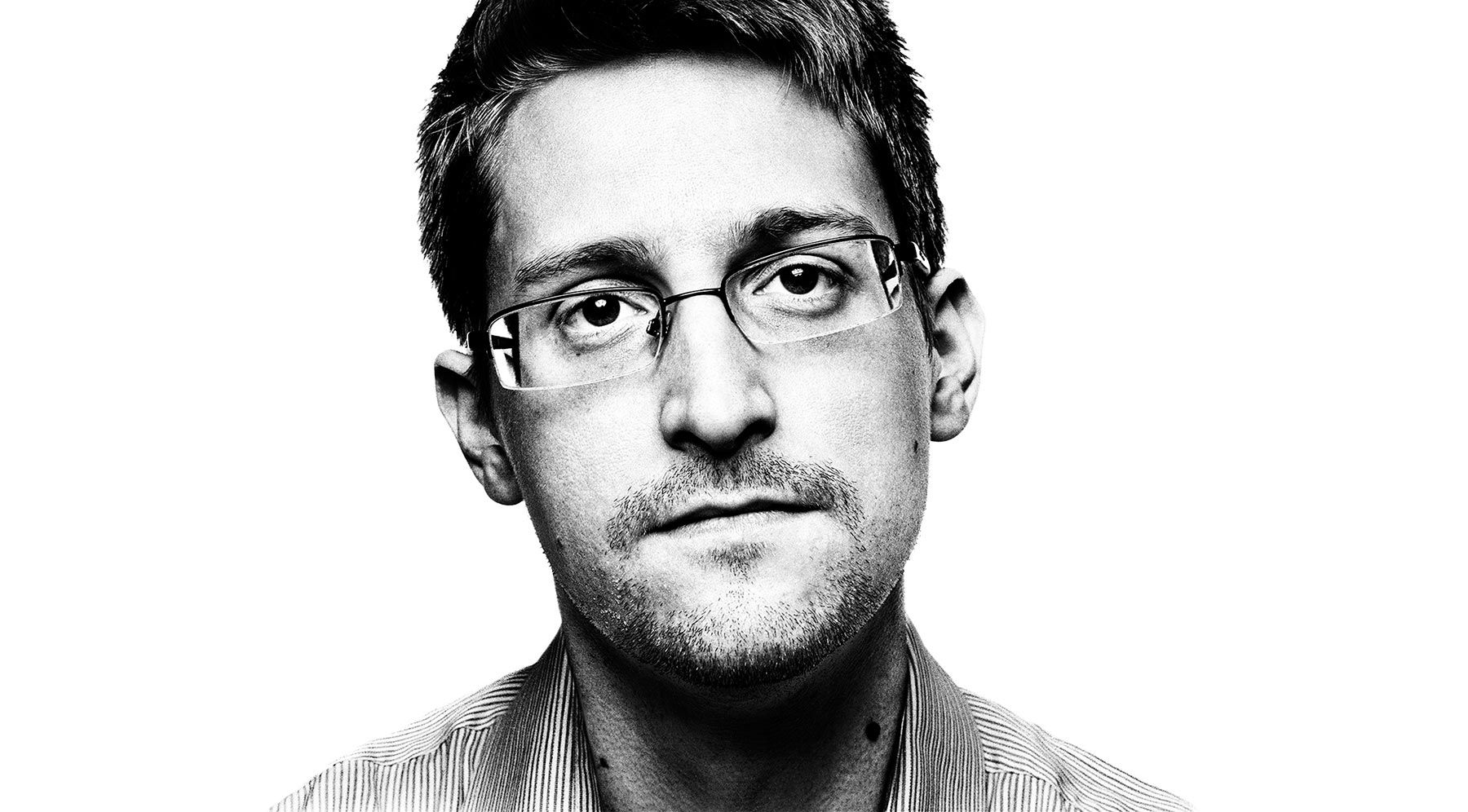
Edward Snowden is a former contractor for the federal government who copied and leaked classified information from the National Security Agency (NSA) in
2013 without prior authorization. His disclosures revealed numerous global surveillance programs, many run by the NSA and Five Eyes with the cooperation of telecommunication companies and European governments.
Snowden was hired by Booz Allen Hamilton, an NSA contractor, in 2013 after previous employment with Dell and the CIA. On May 20, 2013, Snowden flew to Hong Kong after leaving his job at an NSA facility in Hawaii and in early June he revealed the thousands of classified NSA documents that are now public.
In 2009, Snowden began work as a contractee for Dell,[21] which manages computer systems for multiple government agencies. Assigned to an NSA facility at Yokota Air Base near Tokyo, Snowden instructed top officials and military officers on how to defend their networks from Chinese hackers.[16] During his four years with Dell, he rose from supervising NSA computer system upgrades to working as what his résumé termed a "cyberstrategist" and an "expert in cyber counterintelligence" at several U.S. locations.[43] In 2011, he returned to Maryland, where he spent a year as lead technologist on Dell's CIA account. In that capacity, he was consulted by the chiefs of the CIA's technical branches, including the agency's chief information officer and its chief technology officer.[16] U.S. officials and other sources familiar with the investigation said Snowden began downloading documents describing the government's electronic spying programs while working for Dell in April 2012.[44] Investigators estimated that of the 50,000 to 200,000 documents Snowden gave to Greenwald and Poitras, most were copied by Snowden while working at Dell.[4]
In March 2012, Dell reassigned Snowden to Hawaii as lead technologist for the NSA's information-sharing office.[16] At the time of his departure from the United States in May 2013, he had been employed for 15 months inside the NSA's Hawaii regional operations center, which focuses on the electronic monitoring of China and North Korea,[4][45] the last three of which were with consulting firm Booz Allen Hamilton.[46][47] While intelligence officials have described his position there as a "system administrator," Snowden has said he was an "infrastructure analyst," which meant that his job was to look for new ways to break into Internet and telephone traffic around the world.[48] On March 15, 2013—three days after what he later called his "breaking point" of "seeing the Director of National Intelligence, James Clapper, directly lie under oath to Congress"[49]—Snowden quit his job at Dell.[50] Although he has stated that his "career high" annual salary was $200,000,[51] Snowden said he took a pay cut to work at Booz Allen,[52] where he sought employment in order to gather data and then release details of the NSA's worldwide surveillance activity.[53] According to a Reuters story by Mark Hosenball, while in Hawaii, Snowden "may have persuaded between 20 and 25 fellow workers" to give him their logins and passwords "by telling them they were needed for him to do his job as a computer systems administrator."[54] NBC News reported that the NSA sent a memo to Congress and "[w]hile the memo's account is sketchy, it suggests that, contrary to Snowden's statements, he used an element of trickery to retrieve his trove of tens of thousands of classified documents."[55][56][57] This report was disputed,[58] with Snowden himself saying in January 2014, "With all due respect to Mark Hosenball, the Reuters report that put this out there was simply wrong. I never stole any passwords, nor did I trick an army of co-workers."[59][60] Booz Allen terminated Snowden's employment on June 10, 2013.[61]
A former NSA co-worker told Forbes that although the NSA was full of smart people, Snowden was "a genius among geniuses," who created a backup system for the NSA that was widely implemented and often pointed out security bugs to the agency. The former colleague said Snowden was given full administrator privileges, with virtually unlimited access to NSA data. Snowden was offered a position on the NSA's elite team of hackers, Tailored Access Operations, but turned it down to join Booz Allen.[62]
A source "with detailed knowledge on the matter" told Reuters that hiring screeners for Booz Allen had found some details of Snowden's education that "did not check out precisely," but decided to hire him anyway; Reuters stated that the element which triggered these concerns, or the manner in which Snowden satisfied the concerns, were not known.[22] The résumé stated that Snowden attended computer-related classes at Johns Hopkins University. A spokeswoman for Johns Hopkins said that the university did not find records to show that Snowden attended the university, and suggested that he may instead have attended Advanced Career Technologies, a private for-profit organization which operated as "Computer Career Institute at Johns Hopkins."[22] The University College of the University of Maryland acknowledged that Snowden had attended a summer session at a UM campus in Asia. Snowden's résumé stated that he estimated that he would receive a University of Liverpool computer security master's degree in 2013. The university said that Snowden registered for an online master's degree program in computer security in 2011 but that "he is not active in his studies and has not completed the program."[22]
Snowden said that, using "internal channels of dissent", he had told multiple employees and two supervisors about his concerns that the NSA programs were unconstitutional. An NSA spokeswoman responded, saying they had "not found any evidence to support Mr. Snowden's contention that he brought these matters to anyone's attention".[63] Snowden elaborated in January 2014, saying "[I] made tremendous efforts to report these programs to co-workers, supervisors, and anyone with the proper clearance who would listen. The reactions of those I told about the scale of the constitutional violations ranged from deeply concerned to appalled, but no one was willing to risk their jobs, families, and possibly even freedom to go through what [Thomas Andrews] Drake did."[60][64] In March 2014, during testimony to the European Parliament, Snowden wrote that before revealing classified information he had reported "clearly problematic programs" to ten officials, who he said did nothing in response.[65] In a May 2014 interview, Snowden told NBC News that after bringing his concerns about the legality of the NSA spying programs to officials, he was told to stay silent on the matter. Snowden said:
The NSA has records—they have copies of emails right now to their Office of General Counsel, to their oversight and compliance folks from me raising concerns about the NSA's interpretations of its legal authorities. I had raised these complaints not just officially in writing through email, but to my supervisors, to my colleagues, in more than one office. I did it in Fort Meade. I did it in Hawaii. And many, many of these individuals were shocked by these programs. They had never seen them themselves. And the ones who had, went, "You know, you're right. ... But if you say something about this, they're going to destroy you".[11]
In May 2014, U.S. officials released a single email that Snowden had written in April 2013 inquiring about legal authorities but said that they had found no other evidence that Snowden had expressed his concerns to someone in an oversight position.[66] In June 2014, the NSA said it had not been able to find any records of Snowden raising internal complaints about the agency's operations.[67] That same month, Snowden explained that he himself has not produced the communiqués in question because of the ongoing nature of the dispute, disclosing for the first time that "I am working with the NSA in regard to these records and we're going back and forth, so I don't want to reveal everything that will come out."[68]
In his May 2014 interview with NBC News, Snowden accused the U.S. government of trying to use one position here or there in his career to distract from the totality of his experience, downplaying him as a "low level analyst." In his words, he was "trained as a spy in the traditional sense of the word in that I lived and worked undercover overseas—pretending to work in a job that I'm not—and even being assigned a name that was not mine." He said he'd worked for the NSA undercover overseas, and for the DIA had developed sources and methods to keep information and people secure "in the most hostile and dangerous environments around the world. So when they say I'm a low-level systems administrator, that I don't know what I'm talking about, I'd say it's somewhat misleading."[11] In a June interview with Globo TV, Snowden reiterated that he "was actually functioning at a very senior level."[69] In a July interview with The Guardian, Snowden explained that, during his NSA career, "I began to move from merely overseeing these systems to actively directing their use. Many people don’t understand that I was actually an analyst and I designated individuals and groups for targeting."[70] Snowden subsequently told Wired that while at Dell in 2011, "I would sit down with the CIO of the CIA, the CTO of the CIA, the chiefs of all the technical branches. They would tell me their hardest technology problems, and it was my job to come up with a way to fix them.”[16]
Of his time as an NSA analyst, directing the work of others, Snowden recalled a moment when he and his colleagues began to have severe ethical doubts. Snowden said 18 to 22-year-old analysts were suddenly "thrust into a position of extraordinary responsibility, where they now have access to all your private records. In the course of their daily work, they stumble across something that is completely unrelated in any sort of necessary sense—for example, an intimate nude photo of someone in a sexually compromising situation. But they're extremely attractive. So what do they do? They turn around in their chair and they show a co-worker ... and sooner or later this person's whole life has been seen by all of these other people." As Snowden observed it, this behavior was routine, happening "probably every two months," but was never reported, being considered among "the fringe benefits of surveillance positions."[71]